
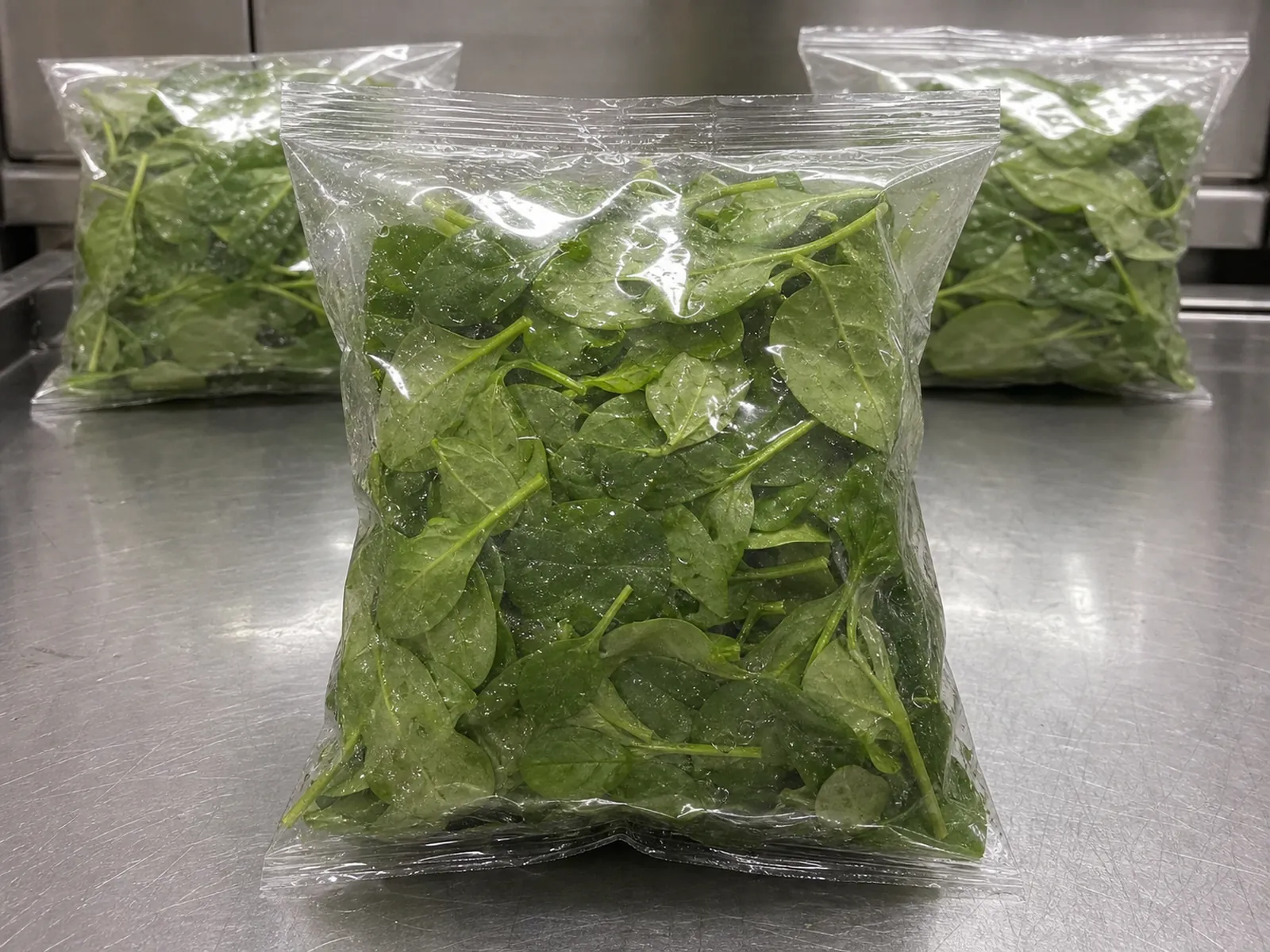
Short answer: Leafy greens packaging should be selected from the product and packing process outward. Define the produce, pack weight, rigid or flexible format, closure or sealing method, line speed, temperature journey, visibility and airflow requirements, case configuration, forecast volume and approval process. Anti-fog treatment and micro-perforation solve different problems and neither one establishes a shelf-life result.
Mesclun, baby leaf, spinach, rocket and herbs can look similar on a retail shelf while behaving differently during packing, cooling, transport and display. Cut size, surface moisture, product temperature, pack weight, film area and handling all influence the package. A useful commercial review therefore starts with the current operation and the observed problem, not with a generic request for a "salad bag" or "clear tray".
1. Choose the package format before adding performance features
The first decision is whether the programme needs a rigid container, flexible bag or another line-compatible format. PET punnets and clamshells can provide a defined shape, clear presentation and protection through handling and stacking. CPP produce bags can suit flexible packing programmes where bag construction, sealing and print need to work with the product and equipment.
Format choice should account for target fill weight, pack dimensions, closure, case count, pallet pattern, label area and retail orientation. A visually attractive pack that does not denest, seal, stack or case-pack reliably is not a workable commercial solution. Current samples and line information make the format discussion faster.
| Decision area | PET rigid format discussion | CPP flexible format discussion |
|---|---|---|
| Presentation | Footprint, depth, clarity, lid and label area | Bag dimensions, film appearance, print and shelf orientation |
| Packing process | Denesting, filling, closing, labelling and case packing | Bag feed or film handling, filling, sealing and throughput |
| Handling | Stacking, compression, closure retention and transport | Seal integrity, puncture, product movement and case fit |
| Commercial input | Existing or custom format, tooling, quantity and freight | Construction, gauge, printing, converting run and freight |
2. Separate visibility from airflow
Condensation can reduce shelf visibility, while produce respiration and moisture can create a different airflow question. Anti-fog film is intended to change how moisture appears on the film surface so the packed product remains easier to see. It does not remove water from the pack and does not define ventilation by itself.
Micro-perforation introduces defined openings into film or a bag. The useful pattern depends on the produce, film construction, pack geometry, sealed area, temperature conditions and target outcome. Anti-fog and micro-perforation may both be considered, but they remain separate specification decisions and should be evaluated against the actual product and cold chain.
Record when fogging, pack inflation, moisture or product-condition issues appear. Photographs taken at packing, after cooling, after transport and during retail display can give the supplier a clearer starting point. Packed-product trials may be required before a commercial format is approved.
3. Bring the packing line into the brief
State whether the line is manual, semi-automatic or automated. For rigid packs, describe tray or punnet denesting, fill control, lid application, inspection, labelling and case packing. For flexible packs, provide the machine type, current material reference, film or bag dimensions, gauge, sealing arrangement, target throughput and any observed operating limits.
Do not assume that a material used successfully on one leafy-greens line will run the same way on another. Equipment setup, product contamination around the seal, operating temperature and line speed can change the result. Samples should be tied to a defined approval question such as dimensions, line handling, seal performance or filled-product behaviour.
4. Define the cold-chain and validation plan
Document product temperature at packing, cooling method, storage, transport duration and retail display conditions. Also record wash and drying steps where relevant. This information does not create a guaranteed performance prediction, but it helps identify what must be checked in a trial.
Agree who approves the package and what evidence they require. A visual sample, machine trial, filled-product trial and production approval can be separate stages. The customer remains responsible for confirming suitability against the food, process, applicable requirements and intended supply chain.
5. Plan the commercial supply programme
Commercial packaging production is affected by standard or custom format, tooling status, material, dimensions, print, converting method, factory run, forecast volume and freight. Share expected annual or seasonal demand, order pattern, launch date, delivery location and receiving capability. SINOPAC commonly plans around high-volume requirements, including container-based supply programmes where appropriate.
There is no single MOQ or lead time that applies to every leafy-greens pack. Standard unprinted formats and custom printed constructions can follow different routes. Practical MOQ, sample stages, approval timing, production lead time and freight are confirmed after the specification and production route are reviewed.
A concise leafy-greens packaging brief
- Produce type, variety where relevant, condition and target pack weight.
- Current package sample, dimensions, material reference and known issues.
- Rigid or flexible format preference and retail presentation requirements.
- Packing equipment, closure or sealing method and target throughput.
- Temperature journey, cooling, transport and display conditions.
- Visibility, moisture, airflow, strength, print and label requirements.
- Case count, pallet pattern, annual or seasonal forecast and delivery programme.
- Sample, line-trial, filled-product and internal approval requirements.
This information lets a supplier distinguish a material question from a format, equipment or cold-chain question. It also creates a clear basis for comparing samples without making unsupported performance assumptions.