
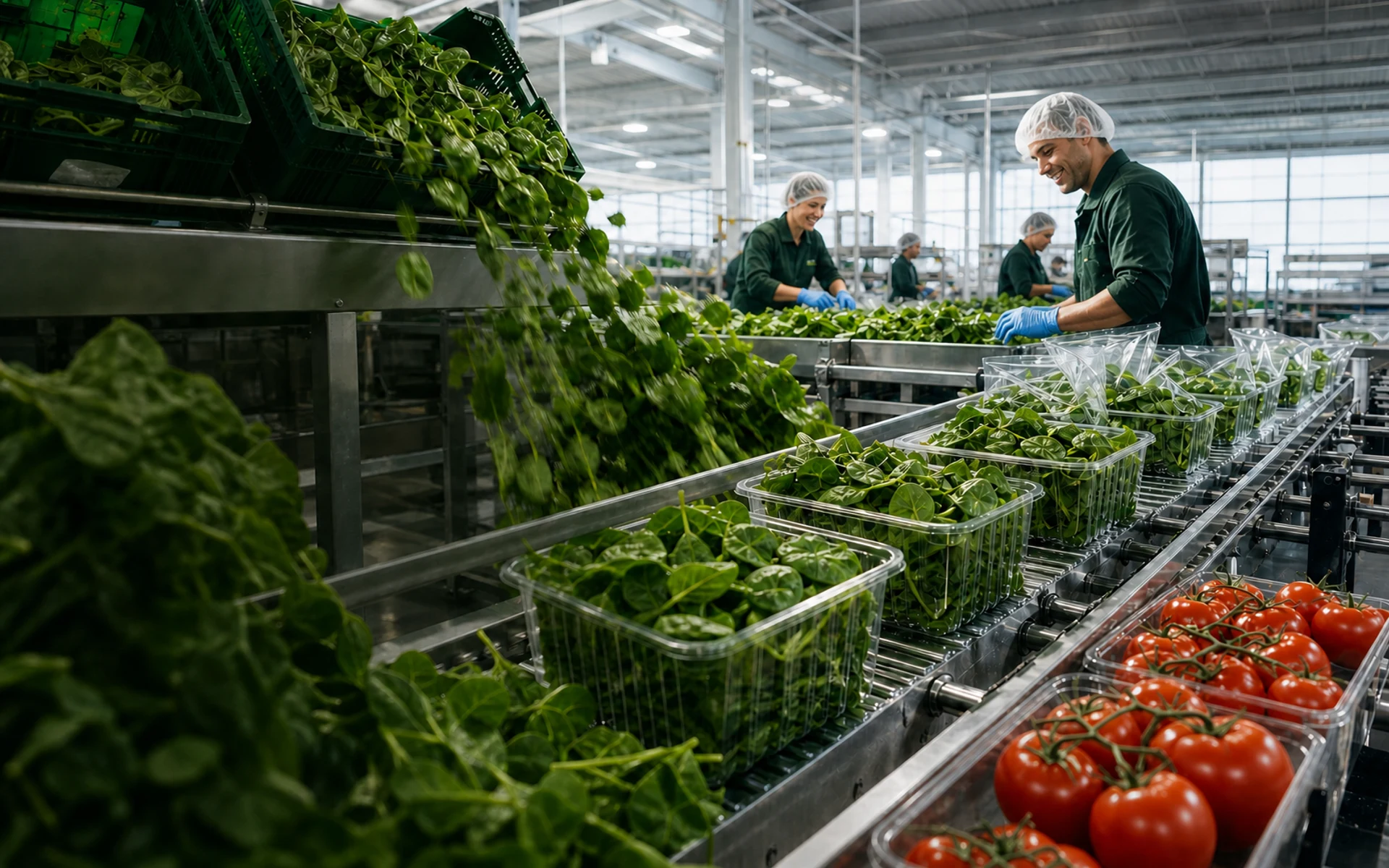
Short answer: To specify commercial produce packaging, define the packed product, target weight, package dimensions, material or performance needs, packing equipment, cold-chain conditions, label or print requirements, forecast volume and delivery programme. A sample of the current pack is often more useful than a product name alone.
A packaging supplier cannot reliably identify a commercial solution from “we need a clear bag” or “we need a tray for salad”. Two packs that look similar can behave differently because the product, fill weight, sealing equipment, storage temperature, airflow and distribution route are different. The purpose of a brief is to make those differences visible before samples or pricing are discussed.
1. Describe the product and route to market
Start with the food itself. Record the produce type, variety where relevant, condition at packing, target pack weight and whether the product is whole, cut, washed or prepared. Then describe where the pack travels: local retail, nationwide distribution, export, food service or another channel.
Include the expected temperature journey from packing through storage, transport and display. This does not determine the material by itself, but it gives the supplier context for visibility, moisture, handling and testing discussions.
2. Document the current package
If there is an existing pack, provide a physical sample, specification sheet or clear photographs with measurements. For a rigid container, record the external length, width, depth, closure style and usable label area. For flexible packaging, record film width, bag length, gauge or material reference, seal arrangement and any perforation or print details.
Explain what is working and what needs improvement. A clear problem statement such as “condensation reduces shelf visibility after chilled transport” is more actionable than “we need better film”.
3. Include packing-line information
Packaging must work inside the operation. State whether packing is manual, semi-automatic or automated. For film and bags, provide the machine type, forming and sealing arrangement, target throughput and any known sealing window. For rigid packs, describe denesting, filling, closing, labelling, case packing and inspection steps.
Where possible, include equipment model information and a short video of the current line. Machine compatibility should be confirmed before a full production commitment.
4. Separate each performance requirement
| Requirement | What to describe |
|---|---|
| Clarity | Where visibility is lost, when fogging occurs and the desired retail outcome. |
| Airflow | Product, current perforation, pack dimensions and observed moisture or inflation. |
| Protection | Crushing, puncture, stacking or transport issues in the current system. |
| Sealing | Equipment, seal type, contamination risk and operating conditions. |
| Presentation | Label area, branding, print, shelf orientation and customer handling. |
Avoid combining different functions into one vague request. Anti-fog treatment and micro-perforation, for example, address different needs and should be evaluated separately.
5. Provide honest commercial volumes
Commercial packaging is planned around production economics and freight. Share an annual or seasonal forecast, expected order pattern, launch timing and receiving capability. If the forecast is uncertain, provide a low, expected and high scenario rather than a single optimistic number.
MOQ can depend on dimensions, material, printing, tooling, production method and factory scheduling. A standard unprinted format may have a different starting point from a custom printed construction.
6. Define the approval path
Identify who approves dimensions, line trials, artwork, product performance and commercial terms. Agree on what a sample is intended to prove. A visual sample, production sample and filled-product trial are not necessarily the same approval stage.
A concise brief to send
- Company, packing location and contact person.
- Product, target pack weight and route to market.
- Current package sample, dimensions and known material.
- Packing equipment and throughput.
- Problems to solve and required performance.
- Print, label and artwork needs.
- Annual or seasonal volume and delivery pattern.
- Target date and internal approval process.
Final suitability should be confirmed against the actual product, packing process and regulatory obligations of the customer. A detailed brief makes that confirmation faster and more useful.